
From Data to Action: What Water Monitoring Reveals About Preventing Water Loss: Non-household customers
Submitted by Andy Smedley – Director - Utilities Manager
This article looks at the impact of customer awareness and engagement in contributing to minimising excessive use of water.
A question to ask you to ponder as you read the article, how does this fit within the definition of water efficiency?
As practitioners we are all dedicated to reducing water use, we are aware of the significant issues we face and how the challenges ahead to consistently and reliably supply water are increasing.
Each of us, and all customers are consumers of water and paying for this through our household bills. We roughly know how much it is costing us, and as a general rule it is safe to say that actions are taken when our household bills suddenly increase.
For non-household customers, the dynamics are different. The link between users and the bill payer is not so clear cut. I don’t know the answer, but if you were to ask non-household customers to list by priority the key challenges they face running their business or organisation, I imagine that water would seldom be high up on the list.
Our water monitoring portal receives and displays water consumption data from thousands of non-household locations across the UK and across all sectors. The data is downloaded and displayed with the objective that people arriving at work have profile data available through the night so that the current profile performance is available at the start of the working day.
A comprehensive automatic alarm system checks the data in terms of; night use in the early hours; peak flows at any time; and trend performance. Bespoke trigger levels are set according to each individual location profile so that they are reflective and appropriate for each location.
For the past 5 years we have been recording interactions with customers when there have been increases in water use. We have been recording the increase in flow rates and the duration before the issue is resolved. Importantly, we also encourage customer feedback to record the failure mode, not only for future reference, but also to build knowledge of trends across non-household customers.
We have built up a record of 5,000 interventions over this period and can see that the average duration of a period of excessive use is currently 3.1 days.
And by obtaining feedback, we have built up a list of failure modes, by type, by response time and by impact on flows.
In general numbers:
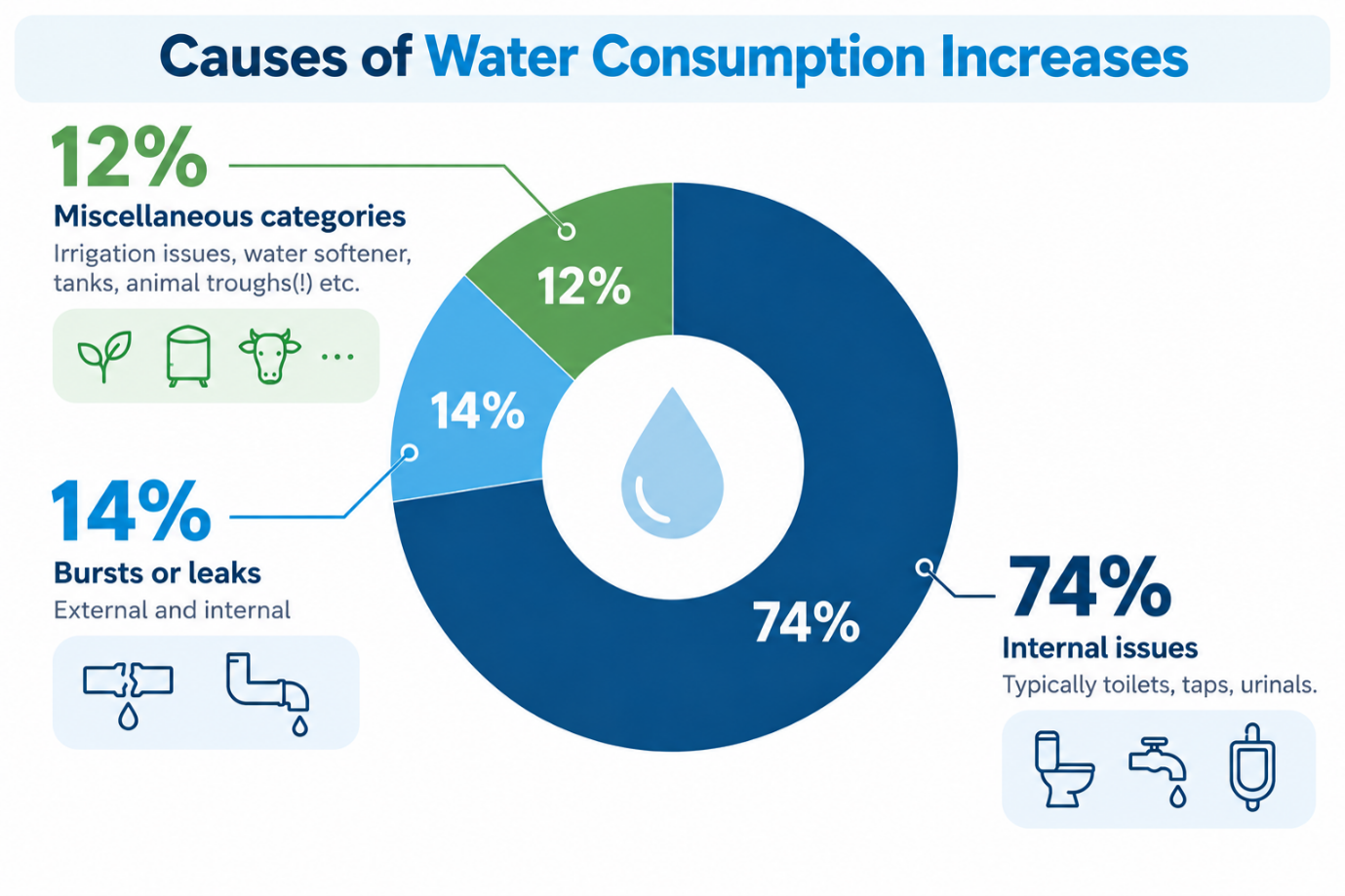
A selection of average response times and excessive flow rates are shown in the table below;
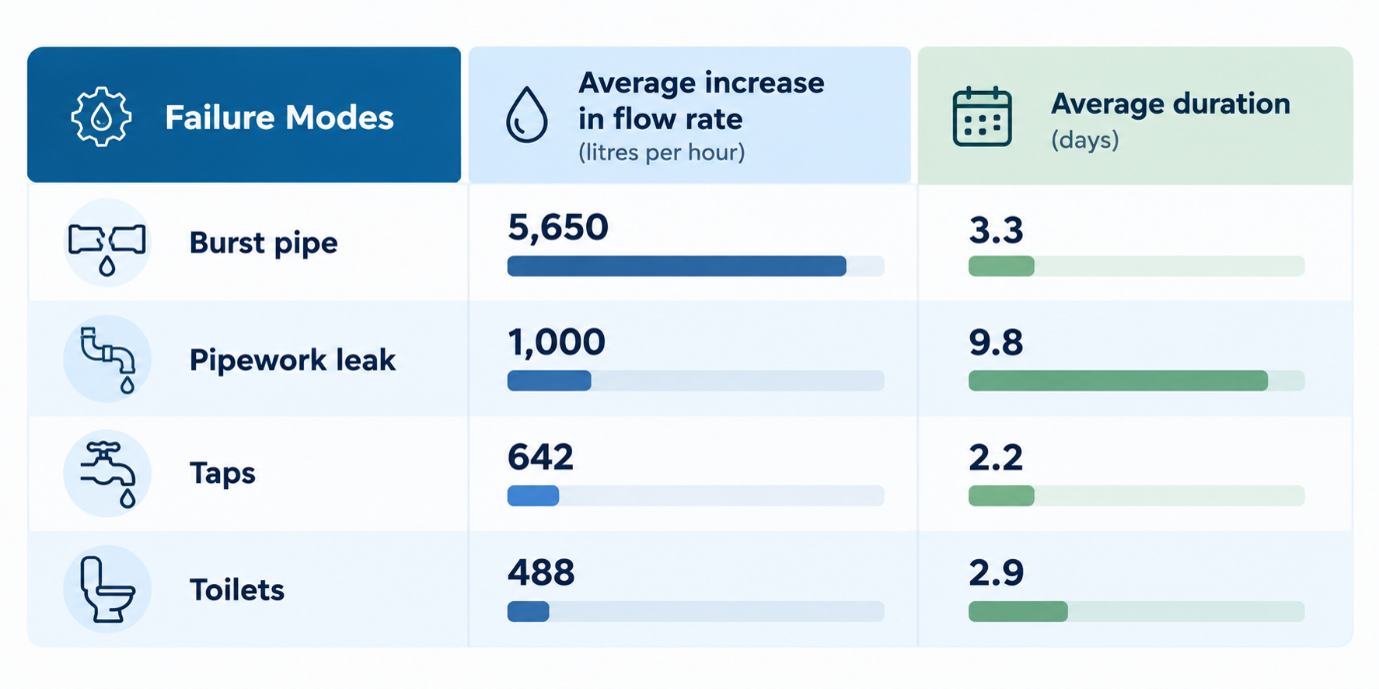
These responses are only possible through a combined effort of good data, an effective alarm and notification process and customers willing to engage and respond.
Providing positive feedback to show customers the impact of their actions, confirming the reductions and savings achieved creates a virtual circle, encouraging customers to act as they can see the direct benefit of their actions.
So, in relation to the earlier question whether this approach contributes to water efficiency? We think so, for example, if the overall response time had been just 24 hours longer than our findings, the impact would be an additional excessive use / water loss of 82,000 cubic metres, or the daytime use of more than half a million household customers.
To know more, get in touch with us - andrew.smedley@umltd.co.uk

More from the water sector
Find out how the UK water sector is informing, innovating, and influencing change