
Networks November: Could the future of water be grown not built?
Event Highlights
Future Water's event brought together leading voices in nature-based solutions (NBS), SuDS innovation, urban resilience, and global water reform to explore one central question: Could the future of water be grown, not built?
The day opened with Gabriela Dotro from the Constructed Wetland Association, who challenged the sector to rethink traditional grey-asset approaches. Gabriela emphasised the importance of designing for multiple benefits, not just biodiversity gains but also community value, and encouraged attendees to “be curious” when exploring new drivers for NBS, from evolving regulation to public pressure around CSOs.
Rethinking SuDS in Practice
Next, Kevin Barton FLI (Robert Bray Associates) explored the realities of SuDS implementation, asking the room whether current approaches are “boo, meh, or yeah?”. While SuDS have moved from siloed thinking to integrated features in many developments, Kevin asked why “bomb-crater” style end-of-pipe solutions still appear across new schemes.
Key messages included:
- Poor SuDS design cannot be justified under “biodiversity net gain”.
- Social value must be central when retrofitting SuDS.
- Funding should recognise the performance of source-control features, not just end-of-pipe basins.
- And crucially: nature-based solutions should start at the top of developments — think blue roofs — not the bottom.
Strengthening Urban Resilience
Howard Gray (GreenBlue Urban) continued the discussion by focusing on measurable benefits for urban resilience. He raised a critical question for planners and developers: how do we embed SuDS into early drainage design alongside grey infrastructure rather than as an afterthought?
Micro-SuDS, Howard noted, offer immense potential for managing surface water flooding when implemented well.
Integrating Nature into the Pipe
A standout session came from Michael Shorey (Enfield Council), showcasing large-scale nature-based solutions across the borough.
Key takeaways included:
- Enfield Council has successfully reintroduced beavers, with eight now actively working along local watercourses.
- Collaboration with Thames Water and Cadent is helping integrate SuDS during infrastructure works, reducing long-term costs for the council.
- Delivering and maintaining Enfield’s SuDS programme costs just £13 per resident per year.
- SuDS should be open and welcoming—remove unnecessary fencing to maximise community value.
Quantifying Whole-Life Value in SuDS
Dr. Peter Melville-Shreeve (University of Exeter) tackled one of the most recurring questions in the sector: how do we quantify the value and performance of SuDS?
Peter highlighted several critical gaps and opportunities:
- High-quality SuDS should be subsidised to encourage innovation.
- The UK still lacks an accessible map of attenuation tanks and system-scale SuDS assets.
- Most evidence relates to unit-scale features like rain gardens, not network-level systems.
- If the sector can locate, monitor, and evaluate existing SuDS, it can unlock funding to improve them and demonstrate their true value.
Global Lessons from New Zealand
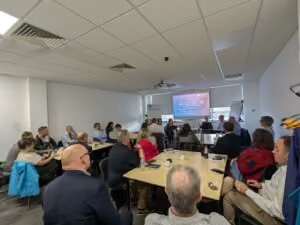
We were delighted to welcome a delegation from New Zealand, sharing international perspectives on nature-positive infrastructure as part of their ongoing water reform.
Chaired by Sasha Barnes (British Expertise International), the panel included contributions from Jamie Sinclair (Watercare Services Limited) and Gillian Blythe (Water New Zealand).
Their insights highlighted:
- How reform is opening opportunities to embed blue-green solutions into new assets.
- Why cultural and community-driven perspectives are essential to meaningful NBS delivery.
- The importance of learning from global practice to accelerate adoption across the UK.

More from the water sector
Find out how the UK water sector is informing, innovating, and influencing change