
HVO advances Group-wide move away from fossil fuel
Date published:
September 2, 2022
Earlier this year M Group Services announced its commitment to halve (Scope 1 & 2) carbonemissions by 2030 and achieve net-zero before 2050. One of the ways we are working towardsachieving this goal is by rolling out sustainable fuel across our core fleet of vehicles.Hydrotreated Vegetable Oil (HVO) is a diesel substitute. M Group Services and its operatingbusinesses are switching to HVO as part of the move away from fossil fuels.
HVO is made from a blend of renewable and sustainable feedstocks such as vegetable and animaloils and waste fats. The fuel only uses waste products not virgin crops meaning we arerepurposing waste to help the planet. We are proud to be working with Green BioFuels (GBF) inthe sourcing and supply of our HVO. With their help we avoid issues of deforestation and palm oiluse which, on occasion, can be associated with HVO use from less sustainable sources.This substitute is more environmentally friendly than petrol or diesel, it reduces CO2 emissions by90%, particulates, also known as atmospheric aerosol particles, by 85% and reduces NitrogenOxide (NOx) emissions by almost a third (30%). With every 330 litres of HVO used we can save upto one tonne of CO2.
At present, HVO can be used in 7.5 tonne sized vehicles and above. It can also be used in plantand equipment hired through M Group Services Plant & Fleet Solutions (MGSPFS). Currently,MGSPFS, Milestone Infrastructure and Morrison Water Services (Yorkshire Water contract) areusing the sustainable fuel source.

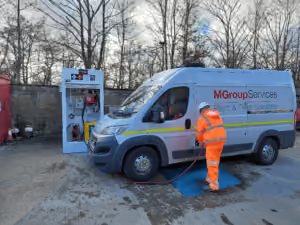
Mark Hamilton, Managing Director of M Group Services Plant & Fleet Solutions, said: “Changing toHVO offers an immediate and practical route away from the use of fossil fuels. It’s another greatexample of the measures we are taking to de-carbonise our work and aligns with our net-zerotargets.”
The switch to HVO is a crucial first step in moving towards cleaner fuel but M Group Services isgoing one step further. We are committed to transitioning our core fleet of over 8,000 vehicles toelectric, as well as installing 75 charging locations on our sites across the UK by 2030. This is inline with The Climate Group’s EV100 global initiative which is bringing together companiescommitted to switching their owned and contracted fleets up to 7.5t to electric.Providing charging points is hugely important to us as part of our own commitment to achievingnet-zero. We are also focused on delivering an EV charging infrastructure to the public. MorrisonEnergy Services is part of a framework agreement with Be.EV, the biggest public charging networkin Greater Manchester that is expanding dramatically across the whole of the north of England.This contract involves us installing 1,000 chargers and four big charging hubs across the North ofEngland.
We also committed to joining the United Nations (UN) Global Compact, the world’s largestcorporate sustainability initiative earlier this year. More than 12,000 companies based in over 160countries have agreed to take action to advance societal and environmental goals.The UN Global Compact centres around 10 principles on environment, human rights, labour andanti-corruption and M Group Services has adopted these principles as part of its strategy, cultureand day-to-day operation in order to make a real difference.Our commitment to achieving net-zero is further reinforced by our support for the Science basedTargets initiative (SBTi) which aims to limit global warming to 1.5oC and cut carbon emissions.

More from the water sector
Find out how the UK water sector is informing, innovating, and influencing change
Open letter: Making Water-Smart Buildings the New Normal
On behalf of its members, partners and supporting organisations, Future Water has written an Open Letter which needs your support.
40 years of Future Water Association: our story so far
From 32 suppliers meeting in Coventry in 1986 to 125+ members today, explore 40 years of Future Water Association shaping the UK water sector.
Murray McIntosh achieves Achilles UVDB Silver Plus accreditation
Murray McIntosh scores 100% in its Achilles UVDB Silver Plus audit, making specialist water recruitment faster and simpler to procure for AMP8 programmes.